





The 2026 Chevy Tahoe and Suburban are two of the most popular full-size SUVs. Both offer spacious three-row seating for up to eight passengers (seven in some trims), powerful engines, and the latest technology. But which one is best for you? This guide compares the two to help you decide.
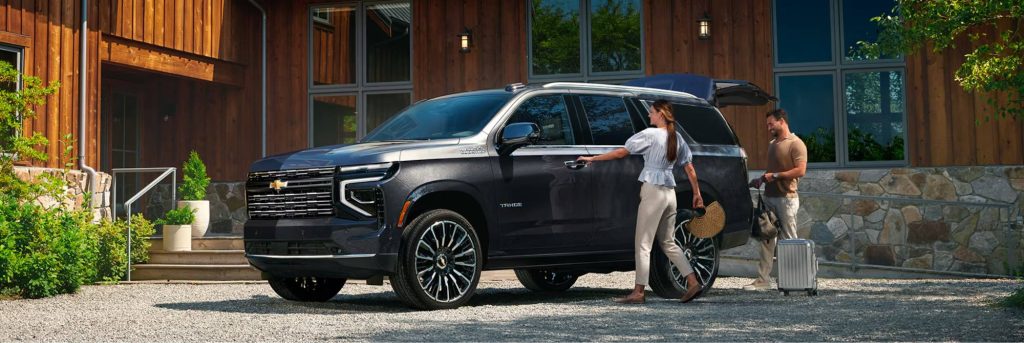
2026 Tahoe vs Suburban: Size and Dimensions Breakdown
While both models are full-size SUVs, there are some noticeable differences. The Suburban is larger, measuring 226.3 inches long vs. 211.3 inches for the Tahoe. Their widths and heights are similar, at around 81 inches wide and 76 inches tall for both models. Each SUV offers around 8-9 inches of ground clearance, which is suitable for light off-road conditions.
Is the Suburban bigger? Yes, the Suburban’s longer 134.10-inch wheelbase (vs. the Tahoe’s 120.90 inches) provides more interior and cargo space across all three rows, making it ideal for large families or anyone needing to carry lots of heavy gear.
Let’s explore the Tahoe vs. Suburban cargo space. The Suburban offers 41.5 cubic feet behind the third row vs. Tahoe’s 25.5 cubic feet. With all rear seats folded, the Suburban maxes out at 144.7 cubic feet, nearly 18% more than Tahoe’s 122.7 cubic feet. Second-row cargo space is larger in the Suburban too, at 93.80 cubic feet vs. the Tahoe’s 72.5 cubic feet. That being said, headroom is the same across both models, as is front and second-row legroom, shoulder room, and hip room.
The difference begins with third-row legroom, with the Suburban offering slightly more legroom (36.70 vs. 34.90 inches) and shoulder room (62.80 vs. 62.70 inches). The Suburban is also heavier than the Tahoe (5,723 vs. 5,580 pounds), which may affect fuel efficiency numbers when fully loaded.
Performance and Capability Face-Off
Both models share the same powertrain lineup: a 5.3-liter V-8 (standard), an optional 6.2-liter V-8, and a 3.0-liter Duramax diesel. The Tahoe slightly edges out the Suburban in towing capacity, with a max tow rating of 8,400 pounds (with Max Trailering package) compared to the Suburban’s 8,300 pounds. This is marginal, as it’s the Tahoe’s slightly lower curb weight that results in better towing efficiency.
Both SUVs have similar gas mileage, though the Tahoe typically offers better fuel economy in the city due to its smaller size. Diesel variants provide the best efficiency. While the EPA has yet to rate the 2026 model, 2025 Tahoe models were rated at 22 mpg city and 26 mpg highway for diesel models, or 15 mpg city and 20 mpg highway for gas variants. The 2025 Suburban was rated at 21 mpg city and 26 mpg highway for diesel models, and the same fuel economy as the Tahoe for gasoline models.
Technology and Interior Features Analysis
Tahoes and Suburbans come equipped with a large 17.7-inch touchscreen infotainment system featuring Google Built-In and wireless Apple CarPlay and Android Auto. Both have the convenience of a wireless charging pad and an onboard Wi-Fi hotspot. A Bose sound system and a rear-seat entertainment system are available on both. Shared advanced safety tech includes available adaptive cruise control with a hands-free driving mode. Standard features include lane-departure warning and lane-keeping assist, and automated emergency braking with pedestrian and cyclist detection.
The overall interior design features and materials are nearly identical across the two. The second-row seats can slide forward to give access to the third row. The cargo space in the back has a flat and low load floor for easy storage. Both have standard cloth seats or upgraded materials, real wood accents, perforated leather, and ambient lighting in higher trims.
Trim Levels and Pricing Structure
The Chevy Tahoe and Suburban are available in the same six trim levels, ranging from the base LS to the top High Country. The Tahoe is slightly cheaper with a starting MSRP of around $62,995 vs. the Suburban’s $65,995 for the base models. This price difference can be seen across the lineup, with the Suburban costing slightly more at each trim than the Tahoe due to its slightly larger size.
Each SUV caters to different needs. The Tahoe has a more affordable starting price, which may be a drawcard for drivers wanting a full-size SUV but in a slightly smaller, more maneuverable option. The Suburban’s price is a little higher but it provides extra space and versatility.
Real-World Ownership Considerations
The Chevy Tahoe’s smaller footprint is better for city driving and parking, while the Suburban excels on longer road trips with more passengers. The Tahoe offers a tighter turning radius (37.8 feet vs. 41.5 feet curb to curb). Both vehicles share maintenance costs and warranty coverage typical of Chevy full-size SUVs, with strong resale values. Fuel costs may be slightly higher for the larger and heavier Suburban. This may influence cost-conscious buyers.
Which SUV Fits Your Lifestyle Best?
Is a Suburban bigger than a Tahoe? Yes. But both are excellent options. Choose the Tahoe if:
- You want easier handling with generous space.
- You want the largest towing capacity.
- You’re deciding based on budget.
Choose the Suburban if:
- You want more space for passengers.
- You often travel with large families or gear.
- You want more flexible space for cargo.
Making the Right Choice in 2026
Both the 2026 Chevrolet Tahoe and Suburban have powerful engines, advanced tech, and family-friendly interiors. The key difference is the Suburban’s larger size. It offers more cargo and passenger space, while the Tahoe’s slightly smaller dimensions are better for towing and maneuverability. Think about your priorities on space, towing, and budget to choose the best fit. Need help deciding? Visit Titus-Will Chevrolet and take both models out for a test drive to experience the differences for yourself.
Connect with us


